Articulating Colonoscopy Snare
Project lead on a five-person team. A 3.4 mm steerable sheath that guides a medical snare through the 3.6 mm working channel of a colonoscope, giving the physician full 360° articulation of the snare independently of the scope — designed against the working requirements of a practising gastroenterologist.
- Role
- Project lead
- Organisation
- UCLA Bionics Lab
- Dates
- Jan 2026 – May 2026
- Status
- Complete
- Tags
- Medical device · Pull-wire actuation · Nitinol · Prototyping
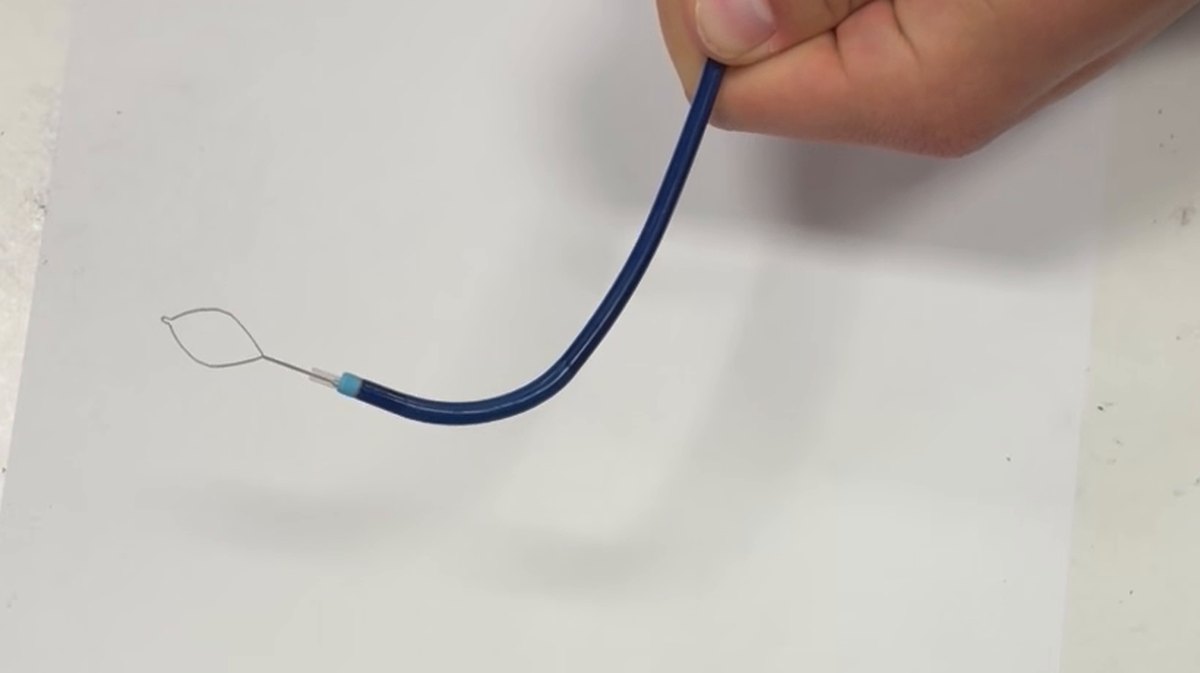
- Outer diameter
- 3.4 mm — about a plastic straw
- Fits
- 3.6 mm adult colonoscope working channel
- Articulation
- 360° of angular access at the distal tip
- Actuation
- Two pull wires on spools, vertical handle
- Control
- Single-handed, independent of the scope
- Team
- Five people — I grew into the lead role
The device in motion
Left is the final design: the medical-grade 3.4 mm sheath, articulating at the tip with the snare running through its lumen. Right is where it started — the first working prototype at roughly 10 mm, built from 3D-printed ribs over a flexible tube, which is what proved the two-wire mechanism actually worked.
Why it exists
A colonoscope is steerable. The snare that comes out of the end of it is not — it can only be pushed straight out of the working channel. To reach a polyp, the physician has to aim the entire scope, and the scope is too large to point precisely at a small target.
The result is that some polyps are difficult to reach, and when the snare is extended it frequently sits in front of the camera and blocks the view of the thing being removed. The goal was a snare that can be aimed independently of the scope it came out of.
Requirements
Fit inside the 3.6 mm working channel of an adult colonoscope — this is the constraint everything else bends around. Be controllable one-handed by a physician who is already operating the scope with the other. Deliver full 360° of angular access at the tip.
My role
I did not start as team lead; I grew into it. I ran the research, the prototyping and the design of the actuation system, and I owned communication in both directions — pulling requirements out of the people who would use the device and keeping our PI current on where the project stood.
The requirements came from a medical expert in Texas. Working directly with him meant the device was designed against how one physician actually works rather than against a generic specification, which is what made the tradeoffs decidable.
I also ran the outside relationships: once the design was settled I worked with medical device manufacturers to get a working prototype in hand, tested it with our snares, and showed the results back to our physician partner.
How it works
The design is a steerable sheath that passes down the colonoscope's working channel, with the snare running through the sheath's own lumen. Once the sheath is protruded past the end of the scope, its distal section — deliberately flexible — can be deflected independently of the scope.
Deflection comes from two pull wires anchored at the tip and wound on spools in a vertical handle. Tensioning one wire bends the tip toward it; combined with rotation, that gives the snare 360° of angular access to point at a polyp the scope itself cannot aim at.
The actuation system
Choosing pull wires settles how the tip bends but not how the physician drives them, and that half is its own design problem. Whatever holds the wires has to sit in one hand, alongside a scope the physician is already driving with the other, and convert a small comfortable hand motion into enough wire travel to deflect the tip through its full range.
So I designed a custom actuation handle for the two-wire approach: the wires are anchored at the distal tip, run back through the sheath, and terminate on spools carried in a vertical handle. Turning the spool takes up one wire and pays out the other, bending the tip toward the tensioned side; combined with rotating the whole assembly, that is what produces 360° of angular access.
I prototyped and validated the handle alongside the sheath rather than after it, because the two only make sense together — the wire travel the handle can deliver is what sets how sharply the tip can bend.
Key decisions
Build a steerable shaft, or integrate one
- Fabricate a braided multi-lumen shaft in-house — needs reflow equipment the lab does not have
- A custom machined articulating tip
- Buy an off-the-shelf steerable sheath and build the integration around it
Off-the-shelf steerable sheath as the actuation platform, with custom integration of the snare through its lumen.
I spent a long stretch of the project studying how commercial steerable sheaths and catheters are actually built and comparing each construction against our own criteria. That research produced the answer: the in-house route was blocked by equipment we were never going to have. Buying the sheath changed the question from “can we manufacture a 3.4 mm braided shaft” to “does the clinical idea work” — which is the question that actually mattered, and the one a working prototype could answer.
Driving the distal tip
- A thumb gimbal on the handle
- A motorised drive
- Pull wires on spools, driven from a vertical handle
Two pull wires wound on spools.
The gimbal could not convert the small thumb motions available into enough deflection at the tip. The motorised approach grew large and complex quickly, and this has to sit in a physician's hand alongside a scope they are already driving. Pull wires are what commercial steerable devices use, they work one-handed, and — critically — they scale down to 3.4 mm.
What went wrong
We prototyped first at roughly 10 mm, deliberately — 3D-printed ribs threaded over a flexible tube, built at a size we could actually make in the lab. That let us prove the two-wire mechanism worked when integrated with a real snare and a real colonoscope before committing to the hard part.
That is where it stalled. At 10 mm the device is nearly three times too large to enter the working channel, and closing that gap was not a matter of shrinking the model. Making a braided multi-lumen shaft at 3.4 mm needs reflow equipment the lab does not have, so there was no in-house path from a working proof of principle to something that fits a colonoscope.
The way through was to stop trying to build the shaft and start sourcing it. The research into how commercial steerable sheaths are constructed is what identified that route, and working with medical device manufacturers is what turned it into a prototype we could put in front of the physician.
Result
A working prototype at 3.4 mm outer diameter with full 360° of angular access, small enough to pass down an adult colonoscope's working channel, developed toward animal trials. Testing focused on confirming the snare deploys reliably through the sheath and that the assembly holds its size and performance.
We tested the manufactured prototype with our own snares and showed the results to the physician who set the requirements — which is the only review that really counts on a device like this.
Design artifacts
A photo of the prototype next to a ruler or a straw would still land the 3.4 mm point instantly. One shot, next time you have the device in hand.